
PISA 2029 Climate Literacy Framework
At the 30th Conference of the Parties to the United Nations Framwork (COP30), representatives from the Organisation for Economic Co-operation and Development (OECD) presented the preliminary draft of the PISA 2029 Climate Literacy Framework.
Climate literacy is the ability to understand how the climate system works, how human actions affect it, and how climate change impacts people and ecosystems.
PISA 2029 Climate Literacy Framework
While countries may have started to emphasise climate change education, there are no internationally standardised metrics. PISA data in this new domain would allow countries to measure and track the effectiveness of the education systems’ ability to prepare students to meet the challenges of the climate change polycrises, as well as the United Nation’s Sustainable Development Goals (SDGs).

The Climate Literacy Framework notes that education reforms across the world have shown consensus that equipping young people to respond to climate challenges must transcend beyond occasional lessons and extracurricular activities.
Climate change education should be deliberately built into national curricula and standards, assessments, teaching and learning resources, and teacher education, so that every student graduates with the knowledge, skills and attitudes to contribute to a sustainable future.
PISA 2029 Climate Literacy Framework
The knowledge, skills and attitudes are described as the foundational elements of climate literacy, which work together to enable students to develop agency.
The Foundations of Climate Literacy
The lists below include statements and terminology that have been extracted and collated from page 17 of the Climate Literacy Framework.
Knowledge
This dimension includes:
Content Knowledge The facts, concepts, principles, laws and theories related to climate change.
Procedural Knowledge How scientific methods generate and validate evidence e.g. control of variables, replication of measurements, reducing uncertainty.
Epistemic Knowledge How claims are assessed through models, consensus, peer review and the recognition of uncertainty as an inherent feature of science.
Kaiako readers might recognise the above from the 2025 PISA Science Framework. The Climate Literacy Framework adds that "climate-literate individuals possess interdisciplinary knowledge of the causes, consequences, and impacts of climate change on Earth systems, biodiversity, soceities and economies, as well as of possible mitigation and adaptation strategies".
Skills
This dimension includes:
Cognitive, social and emotional skills.
Systems and futures thinking.
Analytical problem solving.
Critical and ethical reasoning to make sense of natural and social phenomena.
Scientific and data literacy, with metacognitive reflection, to assess arguments, distinguish evidence from opinion, evaluate trade-offs and uncertainties.
Attitudes and Values
This dimension emphasises the importance of being able to recognise, reflect upon, and navigate differing values and worldviews. It also includes:
Attitudes and values related to motivation and judgement.
Self-reflection on values, beliefs and life conditions.
Ethic and civic virtues related to equity, fairness, social justice and ecological justice.
Embracing attitudes of concern, responsbility and care.
Recognising and navigating differences, considering alternatives and solutions.
Climate Literacy Competencies
The knowledge, skills, attitudes and values that form the foundations of climate literacy also serve as the cognitive and emotional resources that learners draw upon when enacting climate-related competencies.
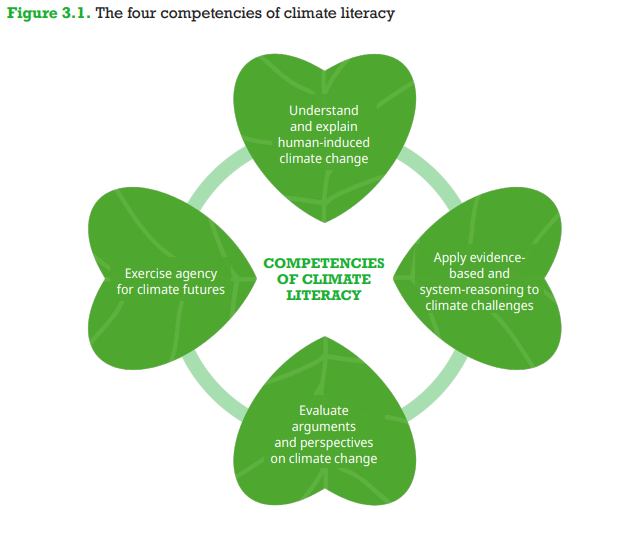
Each of these interconnected competencies also have a set of three sub-competencies.
Understand and explain human-induced climate change.
1.1 Understand and explain the climate and other Earth systems
1.2 Understand and explain the interactions among humans, the climate and other Earth Systems.
1.3 Understand and explain ways to mitigate and adapt to climate change.
Apply evidence-based reasonig to climate challenges.
2.1 Identify reliable evidence on human-induced climate change.
2.2 Investigate climate issues using models and data.
2.3 Integrate diverse sources of evidence to inform decisions on climate issues.
Identify and evaluate diverse perspectives, values and worldviews on climate change.
3.1 Identify and evaluate different types of claims about climate change.
3.2 Identify and evaluate different perspectives, values and worldviews on climate change.
3.3 Construct arguments and communicate on climate change.
Exercise agency for climate futures
4.1 Envision just and sustainable futures.
4.2 Formulate strategies and plan projects.
4.3 Reflect critical on projects and solutions.
The Climate Literacy framework explores each of the sub-competencies in detail by providing proficiency levels and examples of performance at each level. An example for 1.2 Understand and explain the interactions of among humans, the climate and other Earth systems is included below.

The PISA Science Test
Agency in the Anthropocene added three environmental competencies to the 2025 PISA Science Test:
Explain the impact of human interactions with Earth’s systems.
Make informed decisions to act based on evaluation of diverse
sources of evidence and application of creative and systems thinking to
regenerate and sustain the environment.
Demonstrate hope and respect for diverse perspectives in
seeking solutions to socio-ecological crises
The PISA Climate Literacy framework builds upon this by creating measures of climate literacy that can be included in existing PISA domains.
In the next PISA cycle, new items addressing climate literacy will be developed for the science assessment and for the innovative domain of Media and AI Literacy
PISA 2029 Climate Literacy Framework
As epistemic knowledge and evidenced-based reasoning are required foundations of climate literacy, and are already part of the PISA Science Framework, PISA 2029 will include material from the PISA 2025 science assessment.
Closing RemarksAs Aotearoa New Zealand undergoes curriculum reform in the context of global priorities enacted through OECD publications such as the PISA 2025 Science Framework and the 2029 Climate Literacy Framework, we close our article with the following guiding questions:
|


Comments