
Video & Transcript: Unpacking the Draft Science Learning Area (Year 0 - Year 8)
Updated: Jan 19
For kaiako who couldn’t make the Science Years 0–8 (draft content) presentation on 27 November 2025, Bay Science has transcribed the session alongside the presentation slides. A link the official recording is also available.

Looking for the Year 9 and 10 transcript and video?
Transcript: Unpacking the Draft Science Learning Area
Sections in green relate to the Science learning area.
Click on any of the slides to navigate the slide deck left or right.
 | Kia ora, everyone. Welcome to this presentation: Unpacking the Science Learning Area for Years 0 to 8. My name is Matthias Säuberlich I’m the Manager of Learning Design for the New Zealand Curriculum here in the Curriculum Centre at the Ministry of Education, coming to you from a cold-ish, slightly miserable Wellington day. This session today does not have a Q&A function. It’s a presentation format. But as we’re going through, if you have questions or comments, please note them down. Towards the end of the presentation, there will be a slide with an email address you can send any questions or feedback to. I will open the session today with a karakia. This karakia has been gifted to us by Dr. Wayne Nata, and Wayne is pleased to see us continuing with our use of Te Mātaiaho. It has also been supported by the Māori Ministry Advisory Group. Karakia (spoken as presented). |
 | If you’ve attended one of these sessions in the last couple of days, you will notice that this presentation covers the same information about Te Mātaiaho — the development of the learning areas, what a “knowledge-rich curriculum” is, and the knowledge-and-practice structure. We hope hearing it again will reinforce your understanding. Alternatively, you probably have time for a cup of tea if you’ve heard it often enough. |
 | Our strengthened national curriculum is knowledge-rich, grounded in the science of learning, and nationally consistent so that we enable our learners to get a world-leading education where ever they go to school. The New Zealand Curriculum has been made clearer and easier to use, supporting teachers to raise achievement and reduce the equity gap by introducing greater direction and clearer progressions. It provides clarity about what to teach, how to teach it, and when, from Year 0 through to Year 13. This ensures our national curriculum is internationally comparable and focuses on excellence, providing New Zealand students with the knowledge, skills, and capabilities to thrive in the workforce and in society generally. So, what is a knowledge-rich curriculum? |
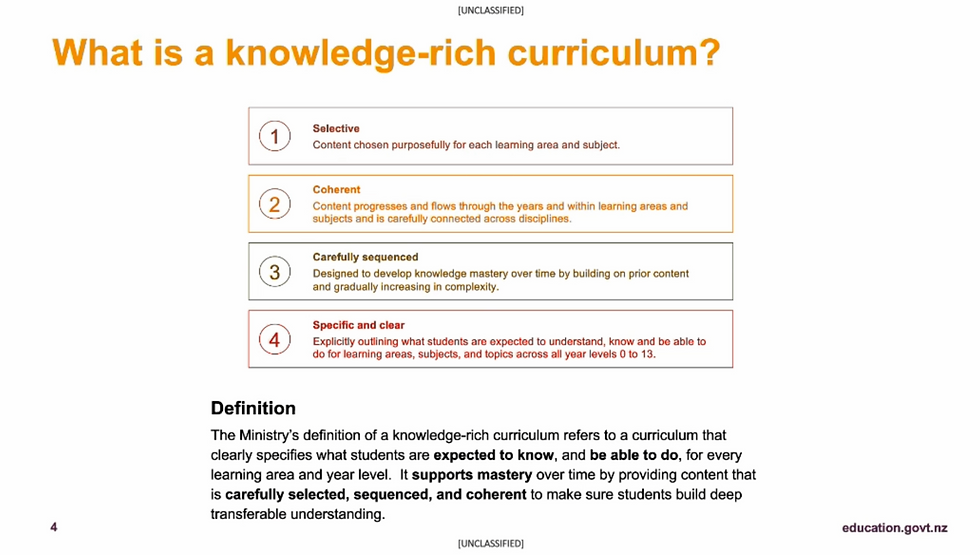 | The Ministry’s definition refers to a curriculum that clearly specifies what students are expected to know and be able to do for every learning area and year level. It supports mastery over time by providing content that is carefully sequenced, selected, and coherent, making sure that students build deep, transferable understandings. |
In this short video, the principal at Silverstream School talking about how they’ve introduced a knowledge-rich curriculum into their school. Video plays. Knowledge-rich curriculum means to us explicit teaching of subject-specific knowledge, so that we can take knowledge, refer back to it, apply it to situations, so that students are always retrieving and repeating information so that it sticks for them. It’s been introduced into our school really well by having a very precise and sequenced way of introducing professional learning to our teachers. That’s been informed by the science of learning and also cognitive load theory. Reducing the cognitive load for students and for the teacher in the classroom makes a huge impact on their ability to stay focused. When you’ve got a precise curriculum that’s sequenced and structured, you’ve got groups of teachers working together to produce resources and use the Ministry resources to deliver that curriculum. We can see an immediate improvement in teacher wellbeing. They don’t have to write a curriculum, write a lesson plan, teach multiple groups of kids, differentiate the curriculum, and then assess all of those different groups. Video ends. A key point from that clip is that the school really thought about how to sequence their rollout and planned it well. We don’t expect every school to implement every aspect of the learning area perfectly at the start of the year. Schools have the freedom to decide how to progressively implement within their own context, taking into account the science of learning and cognitive load for both teachers and students. | |
 | We’ve been on quite a journey developing the draft curriculum over the last 18 months. The content has gone through iterative stages of development, drafting frameworks, drawing on research evidence, academic papers, international jurisdictions, good practice pedagogy, and consulting with academics and curriculum design experts. The Ministry writing teams develop content with input from and collaboration with teachers, school leaders, and subject matter experts and academia. Then the content goes through continual review and refinement involving subject matter expert groups, sector representatives, focus groups, consultation and engagement with school leaders and teachers - which is what we're up to right now - before being signed off by the Minister's coherence group and, finally, the Minister. The formal release of the full and final curriculum follows. We then publish the approved curriculum and package of support materials, including what you told us and how we respond to reports summarizing what we heard and the actions we took to respond to the feedback. So, as you can see, the content goes through a number of stages drafting, reviewing, refining before it's finalized. |
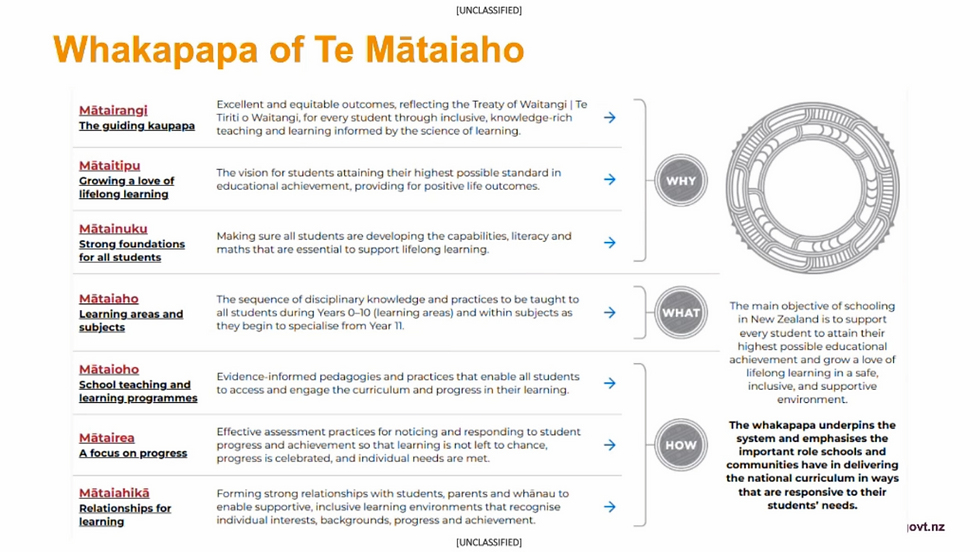 | So the main objective of schooling in New Zealand is to support every student to attain the highest possible educational achievement and grow a level of lifelong learning in a safe, inclusive and supportive environment. That is the main objective of Te Mātaiaho. The whakapapa of Te Mātaiaho underpins the system and emphasises the important role schools and communities have in delivering the national curriculum in ways that are responsive to their students needs. The whakapapa has been reframed as a system approach. All these components are connected and they work together to bring about change. There are seven components, each component building from the stem ''matai', meaning to observe, examine, and deliberately consider. Mātairangi; The first is the guiding kaupapa. It lays out what it is that we're all intending to achieve here. So it's about reflecting Te Tiriti o Waitangi, excellent and equitable outcomes. It's about having high expectations, and it's about knowledge rich learning that's informed, inclusive and informed by the science of learning. Mātaitipu was our vision to put ambition and achievement at the very heart of the education system. So there's aspirational, equitable and deeply inspiring. But lifelong learning is a journey, and every student is empowered to fulfill the unique potential. Mātainuku is about making sure all students are developing the capabilities literacy, maths that are essential to support lifelong learning. These capabilities are holistic attributes that help students adapt to and apply learning and diverse contexts. For example, self-management, problem solving, and creativity. These capabilities are now embedded in and across the knowledge and practices of each learning area - I'll touch more on these shortly. So these first three contribute to the why. Within Te Mātaiaho, is the place where our learning areas sit. That's where you see the teaching sequences in each of the learning areas. This represents the what of the curriculum. Mātaioho signals the important role of teachers and leaders in bringing the curriculum to life. Schools and classrooms using evidence, informed pedagogies and practices that enable all students to access the full scope of the curriculum and progress in their learning. Mātairea is about progress, and a focus on progress requires high quality assessment information to be used to inform the development and implementation of teaching and learning programs, communicate student progress and achievement to parents, and monitor and evaluate how well the school is supporting every student to progress and achieve across the curriculum. And one of the key aspects is Mātaiahikā, which focuses on the importance of knowing students, where they come from and the cultural capital they then the connection with whanau, the connections with community connections with hapū and iwi, and how they are made with the school to connect the learner to the communities and to their family and whanau. These bottom three really speak to the how of the curriculum. |
In previous versions of the draft learning areas, the understand know do components were explicit and woven together within the progress outcomes for each phase. The shift away from explicitly using this UKD label, as we call it, makes the curriculum easier to navigate, more intuitive to use, and better aligned with how teachers and kaiako plan for learning. It also supports more consistent a nationally coherent approach to curriculum delivery while still enabling rich, localised learning experiences. This change responds to feedback from across the education sector, which highlighted the need for greater clarity and usability while the concepts of understanding, knowledge and practice remain central and now embedded more clearly within the curriculum structure. Understanding is reflected in each learning areas purpose statement, which outlines the big ideas and enduring themes learners develop over time. Knowledge and practices are detailed in the year by year teaching sequences, showing what students need to know and do, and how learning builds over time. And the video here of Graeme Aitken speaking to this change in the UKD model. Video plays Tēnā koutou. My name is Graeme Aitken. I’m a member of the Curriculum Coherence Group. On the release of the English and Maths learning areas, many were asking: what has happened to UKD — Understand, Know, Do — and it’s a fair enough question. The interwoven strands diagram and the colourful UKD progress outcomes had gone. So why did this happen? UKD originated in the design of the Aotearoa New Zealand Histories curriculum. The use of a small set of overarching big ideas — the “understands” — worked well for that curriculum, as did the framing of the “do’s” around the practices of thinking like an historian. At the time, we saw the value of UKD as an organising framework for curriculum. So when, as a member of Ohu Arataki, I became involved with the refresh of other learning areas, I was committed to retaining the UKD structure. But even in those early days, as we began to work with other areas, we found it hard to disentangle the “understands” and the “knows”. Retaining the UKD framing was becoming apparent as a lot of work for a single subject. History was not as easily or meaningfully transferable to learning areas comprising multiple subjects, strands, and elements. The understand–know distinction was especially challenging for writing teams. During the initial refresh, they certainly wrote the big ideas about each learning area, but to keep them at a high level and distinct from the “know”, they became more expressions of the nature, purpose, and value of the learning area — conceptual framings that had characterised Aotearoa New Zealand Histories. As a member of the Curriculum Coherence Group for the new curriculum, I was keen to continue to work with Understand–Know–Do, the UKD structure, but I found the same challenges emerging that we experienced in the refresh. Especially writing “understands” that lived consistently with what we learned. And outside of New Zealand Histories, we found that the “understands” carried more meaning when expressed at the strand — in other words, at the subject level. So you will still see some of them retained within the learning area structure section of the new curriculum. For example, in Mathematics and Statistics: “Algebra develops students’ understanding of how patterns and relationships can be represented using symbols, graphs, and diagrams.” But even these are at a high level. It is really through the interaction of the “knows” and the “do’s” that the most meaningful understandings emerge — not in their prior determination at the overarching level of the learning area. This brings us to now. And today, each learning area sets out a year-by-year teaching sequence, organised around knowledge and practices. The knowledge is clearly defined — now shifted from a separate box at the start of each phase, and organised instead in a year-by-year sequence within the strands and elements of the learning area. These “knows” incorporate both factual content and content at the level of broader understanding. But why change “do” to “practices”? There are two main reasons why this happened. First, as we found with Aotearoa New Zealand Histories, the subjects or disciplines that contribute to each learning area are characterised by particular ways of working and thinking. So, for example, working and thinking as an artist, a musician, an athlete, a scientist, a mathematician, and so on. These ways of working are more than isolated acts of doing — they are connected practices. And so we thought the idea of “disciplinary practices” was a more accurate representation than could be captured by the word “do”. We were also concerned that the word “do” naturally generated an outcome-based frame — what students can do — rather than a teaching frame for what teachers need to teach. So in summary: while the visibility and convenient shorthand of the UKD structure is not as apparent, the underlying idea of knowledge and practice interacting to develop student understanding hasn’t changed. It is just that the process of working with learning areas over a number of years has led to a re-organisation to locate the understanding–knowledge–practice relationship at the level of the teaching sequence — the level at which most teachers will work. Video ends. That was Graeme Aitken of the Ministers Coherence group speaking to the shifts in the UK model. | |
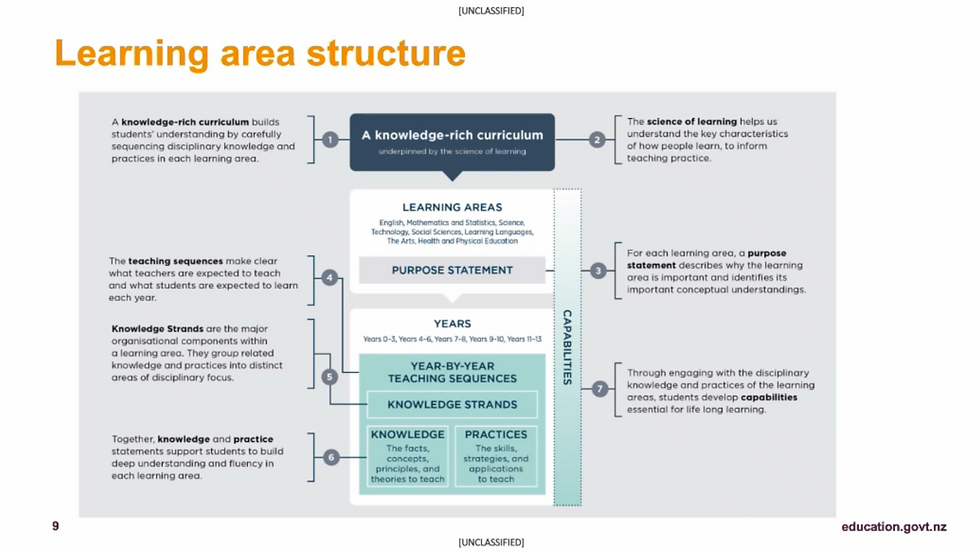 | The design of the knowledge rich curriculum is essential in bridging the knowledge gap. The structure is consistent across all learning areas and you can see it laid out here in this slide. And top left is a knowledge rich curriculum carefully sequences knowledge and practices in each learning area. This is underpinned by the science of learning, meaning it's designed around how students learn best.
Each learning area includes a purpose statement, which explains why the knowledge matters and identifies key conceptual understandings. Learning areas are organised into year by year teaching sequences with clear expectations for what students learn and teachers teach, at each year. W ithin each learning area and knowledge strands which group related knowledge and practices into distinct disciplinary focuses. Disciplinary knowledge, content, concepts and understanding and disciplinary practices, which are the way students engage with and apply that knowledge.
Through this design, students also develop capabilities. These are broad, holistic attributes that enable students to adapt, apply and transfer their learning and diverse changing contexts. Th e next slide explains those a little more. Together, this structure ensures state coherent and transferable learning across all subjects and year levels.
|
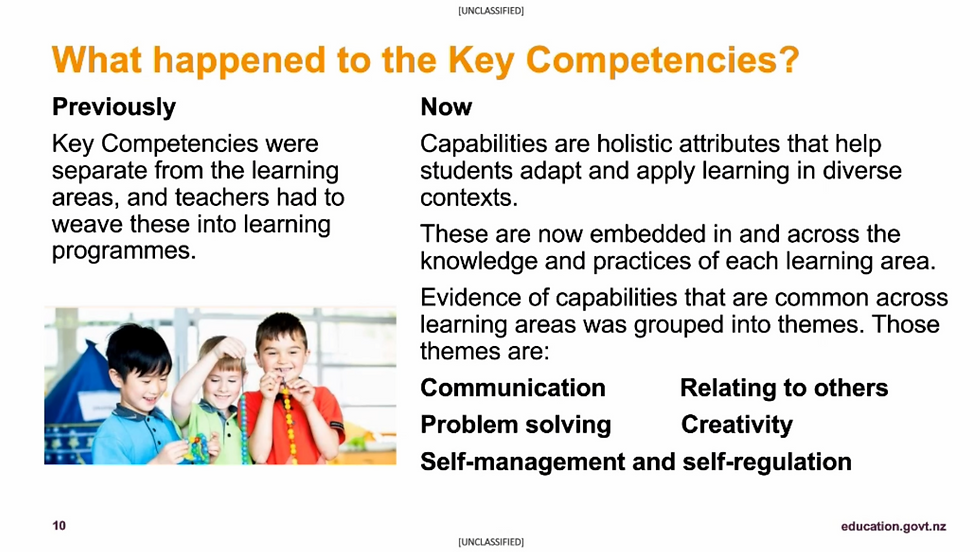 | Key competencies. These were previously in a separate layer in the curriculum that teachers needed to weave into their programs. In the updated curriculum, however, the capability capabilities is the term used for the broad, holistic attributes that enable students to adapt and apply their learning in diverse and changing contexts. They encompass knowledge, skills, dispositions, values, and attitudes. Capabilities are embedded within and across the disciplinary knowledge and practices within the learning areas, and are made clear within the content. The common capabilities were identified through a bottom up approach. This approach ensured the capabilities emerged authentically from the content. Process involved identifying content related to our definition of capabilities within individual learning areas and grouping them into common themes. Our capabilities broadly aligned with many other jurisdictions. The list of common capabilities isn't exhaustive. It's intended to support teachers to notice and develop these. Example resources are available on Tāhūrangi, expanding on each capability and providing learning area specific examples for each phase of learning. These are drafts only. |
 | I'll now move on to the science specific content. This presentation. The new learning area content is much more detailed than in 2007. To get an overview of the complete learning area content quickly and succinctly, these first few pages are a great place to start. |
 | The Learning Area whakatauki. Mā te whakaaro nui e, hanga te whare; mā te mātauranga e whakau. By great thought the house is built; by knowledge it is made firm. |
 | The purpose statement for the science learning area captures these important ideas. Science gives students knowledge and skills to explore the physical and biological world. Students learn to observe, ask questions this to get analyze data and communicate using scientific conventions. Science is evidence based and shaped by inquiry, critique, social and cultural contexts. Scientific knowledge evolves through multiple studies and requires well-supported explanations. Science is collaborative and iterative, valuing innovation and evidence based decision. Students apply disciplinary knowledge and practices to real world phenomena, and science is a human endeavor influenced by diverse times, places, and cultures, including te ao Māori perspectives. |
 | The first paragraph of the introduction summarises the learning journey across years 0 to 10. This describes why the science is important and how it contributes to a student's education. It captures the enduring big ideas in science that students develop understanding over the years, and sets out the context for teaching and learning programs. Each subsequent paragraph focuses on one phase of learning. |
 | In years 0 to 3 teachers support students to begin observing and describing their surroundings, fostering foundational scientific knowledge and curiosity through direct, hands on experiences. In years 4 to 6, teachers help students to ask testable questions, explore cause and effect, and use simple models to explain what they see. In years 7 to 8, teachers support students to apply scientific practices with greater structure and precision, carrying out investigations, analysing and interpreting data, and constructing evidence based explanations of more complex systems. In years 9 to 10, teachers guide students to apply scientific knowledge and practices to increasingly abstract and interdisciplinary contexts. The final sentence indicates how the learning areas progress into specific subjects for years 11 through 13, the Science Learning Area prepares students with the knowledge, practices, and capabilities to access related curriculum subjects for years 11 through 13, including biology, chemistry, Earth and Space science, physics, agricultural and horticultural Science, and Primary Industries. The Learning Area Structure page provides descriptions of the two strands. They are physical science, which focuses on matter, energy, forces, motion, and earth and space systems. Builds understanding of how physical systems behave and interact and how reasoning and modeling explain and predict phenomena. And the second strand is biological science, which focuses on organisms, body systems, genetics, ecosystems, and biological processes. This builds understanding of how living systems function and change, and how science connects to health, sustainability and biodiversity. These strands are broken down into elements. Physical science consists of materials, chemical reactions, matter interactions, and energy motion of forces systems, earth systems, Earth and space. Biological sciences, which is made up biological science, which is made up of organism diversity, body systems and ecosystems. Within these elements there are knowledge which are the core concepts within physical and biological sciences. Practices; skills such as observing, questioning, investigating, analysing, and communicating scientifically... and contexts which are real world applications and cultural perspectives. Perspectives including te ao Māori. I think the key things to notice about the structure, teaching is organised by strands and elements, but teachers have flexibility to adjust order, emphasis and contexts to meet learners needs. Knowledge and practices are integrated, ensuring students apply scientific ideas through inquiry and real world investigations. Human stories and cultural perspectives, including te ao Māori, are embedded to enrich understanding and engage. |
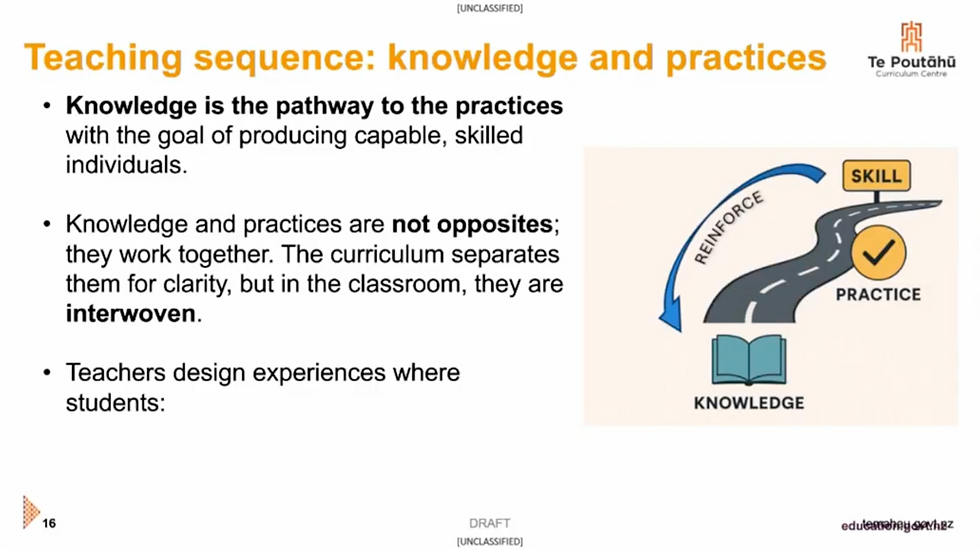 | The knowledge statements and the practice statements are designed to be used by kaiako and kura to create learning programs for ākonga that build coherent conceptual, procedural and cognitive understanding. The application of weaving together the knowledge and the practices should be the starting point for planning of units and lessons by kaiako and kura to identify contextual and pedagogical approaches that are appropriate and engaging for their ākonga and communities. Next we’ll look at an example of the knowledge and practices from year five. Biological science strand and the organism diversity element. |
 | Knowledge statements are not extra content. They make explicit what students need to know to carry out the practices. The practices emphasise inquiry skills like observing, questioning, and analysing data. Teachers have flexibility to adapt the sequence to their learners, adding relevant contexts. In this example, the knowledge statements are explicit about the reproductive strategies that different organisms have and include plants, animals, and fungi. There are a number of examples provided as a starting point for kaiako and kura to use when approaching a learning. The practices here are focusing on investigating, identifying and classifying and comparing. These skills, strategies and applications are directly related to the knowledge. Pedagogical delivery of these interwoven knowledge and practice statements, along with contexts that are appropriate and engaging for ākonga as part of the learning design created by kaiako and kura that are familiar in communities. |
 | You’ll notice in the draft science curriculum, the Nature of Science strand is no longer a separate component. Instead its key aspects such as inquiry, evidence based reasoning and science communication are embedded within the practices for each element and year level. These practices are designed to align with recognised cognitive development models, including Piaget’s stages of cognitive growth, and principles from the science of learning. They support progressive schema building by introducing skills and strategies at developmentally appropriate stages, ensuring that students can integrate new knowledge effectively. Practices are not additional lists of tasks, nor are they exhaustive. Rather, they represent core skills, strategies, and applications that should be explicitly taught alongside the knowledge statements. They provide a framework for how students engage with scientific ideas through investigation, modeling, and reasoning.
While these practices are connected to the suggested contexts, experienced teachers can adapt them to alternative contexts as needed, maintaining coherence with the intended learning progression. |
 | Importantly, the curriculum explicitly embeds diverse perspectives, including te ao Māori, to enrich scientific thinking. This learning will not be left to chance. Additionally, explicit references to integrated teaching opportunities are signaled. Prior knowledge and across learning area connections have been identified as not to be missed learning. You’ll notice the explicit reference of mātauranga Māori within the teaching sequence that supports the learning of science. This example has the Year 4 Earth and space element highlighted in blue. Throughout the teaching sequence, you'll notice references to prior learning, connections between different elements within the sequence, and links to other learning areas. These references are highlighted in yellow here. They are not exhaustive, but signpost opportunities for integration within and across the learning areas. |
 | Throughout this teaching sequence, you'll notice examples of influential scientists and inventors. These individuals represent a wide range of times, crises, and perspectives. Some are living today, shaping the progress of a collective scientific understanding. Others originate from ancient civilizations, reminding us that science is a human endeavor that has evolved over time and continues to develop. It's an integral part of the human story. These examples aren't just about theories or discoveries. They're about people, values, and the implications of their discoveries. These stories can help students see science as not just a tool, but a part of a bigger conversation about people and possibilities. |
 | Throughout this teaching sequence, you'll notice examples of influential scientists and inventors. These individuals represent a wide range of times, crises, and perspectives. Some are living today, shaping the progress of a collective scientific understanding. Others originate from ancient civilizations, reminding us that science is a human endeavor that has evolved over time and continues to develop. It's an integral part of the human story. These examples aren't just about theories or discoveries. They're about people, values, and the implications of their discoveries. These stories can help students see science as not just a tool, but a part of a bigger conversation about people and possibilities. While Agricultural and Horticultural sciences are not explicitly framed within the teaching sequence, their foundational concepts are represented throughout. These aspects provide rich, real world contexts that teachers can use to apply science, knowledge and practices across the curriculum. Such contexts are particularly well-suited to the biological science strand, with concepts like plant structure, reproduction, growth and ecosystems, and can be directly connected to Agricultural and Horticultural practices. |
 | Similarly, the draft curriculum introduces three key changes to Earth and Space science. First, the Planet Earth and Beyond strand now sits within the Physical Science domain under the Earths system and space elements. Second, the social sciences learning area now includes geological, geomorphological and some earth systems content. Third, astronomy remains in the curriculum, but is now explicitly detailed and distributed across phases to align with guidance from the science of learning. |
 | Lastly, the curriculum has addressed outdated energy concepts and models that incorrectly classify the energy transfer mechanisms. For example, light, sound, heat, electricity as energy forms or types, and the use of misleading notions such as flow. Leaving these misconceptions uncorrected risks reinforcing the nature of ideas and students understanding. The revised curriculum now reflects contemporary physics concepts by clearly distinguishing energy forms from the way energy is transferred or transformed. These updates support a more knowledge rich approach to science education and help futureproof students' conceptual understanding of energy. They’re evident in updated descriptions of energy concepts across all disciplines. |
 | The refreshed curriculum framework provides guidance to help schools plan teaching time across learning areas. The time allocation advice in the curriculum reflects what many schools are already doing. In practice, schools retain flexibility to make decisions that set suit their local contexts. The framework includes suggestions on approximate time allocations across learning areas designed to support annual and classroom planning. It suggests up to 20 hours per week for teaching and learning, with approximately five hours for supporting tasks. The structure also allows additional time to be used for activities such as sport, creative arts or cultural programs, depending on each school's priorities. Schools do not have to use this model. One hour each of reading, writing, and math from years 0 to 8 is the only requirement schools have to follow. This is provided as a practical example of time allocations. Importantly, the curriculum encourages schools to look for opportunities to connect and integrate teaching across learning areas. This approach supports efficient use of time while also responding to students strengths and needs. The detailed content in each learning area supports purposeful planning and sequencing, ensuring that curriculum coverage is both balanced and responsive. We're really interested in your feedback on this guidance and how it works for science in your schools and classrooms. |
 | We've produced these resources that you can see here for Science so far, but we'll be producing similar examples and templates of annual and term plans, unit and weekly plans for all learning areas, and an online tool to support teacher planning. These are examples only. We're not saying this is exactly how schools have to plan, but it provides one example of possibility. The science example here shows an annual plan, and then taking one of the Year 6 topics showing an example of what a unit plan might look like. It might be useful for you to use as an example, when looking at how you might plan for science. You can find these by typing ‘Roadshow’ into the ‘Search’ in Tāhūrangi. Next year, we're making more curriculum resources available, such as learning kits that align with the unit plans, providing guidance for teachers to deliver the lessons that make up each unit. Each learning kit will include a series of lesson plans and classroom activities and resources. There will also be curriculum overview products, which include timetabling, the learning area narratives, and curriculum (team?) products. Teacher-only-day and curriculum day materials will also be available shortly for Term One, 2026. |
 | The Mātaiaho and Mātairea sections of the framework signal the important role of teachers and leaders in bringing the curriculum to life in schools and classrooms. This section provides useful direction on planning for coherent and effective teaching, teaching with clarity and purpose, underpinned by the science of learning and creating responsive learning environments. This diagram that you can see on the slide comes from Mātaiaho and shows the dynamic relationship between curriculum, teaching and assessment. |
 | So that was the end of Science learning area specific content. But I did want to use this opportunity to talk about reporting to parents and whanau, and again if you've attended previous sessions, you will have heard this content before. So I want to remind you that updated guidance on reporting to parents and whanau using the five progress descriptors and progress markers is available now on the Reporting to Parents section on Tāhūrangi. Coming out soon as guidance on what reporting to parents and whanau in 2026 will look like, in line with the Year 0 to 10 English and Maths & Statistics learning areas. This will include a comprehensive guidance document, one page quick user guides, as well as exemplar reporting templates, an explanation of expected common components when reporting to parents, and webinars and guidance videos.
There's no expectations that schools make any changes to their reporting before Term One. 2026. The Student Monitoring, Assessment and Reporting Tool, also known as SMART, is a new tool rolling out in 2026 processing learner progress and achievement in Years 3 through 10. SMART will enable twice yearly assessment of reading, writing and maths. Schools will have a choice of SMART, e-ASTTLE, and PATs for 2026. To help schools get the most out of SMART, a comprehensive package of professional learning and development supports will be available from Term One 2026. These supports are designed to build confidence and capability with assessment so that schools can use SMART effectively to inform teaching, learning, assessment and reporting. |
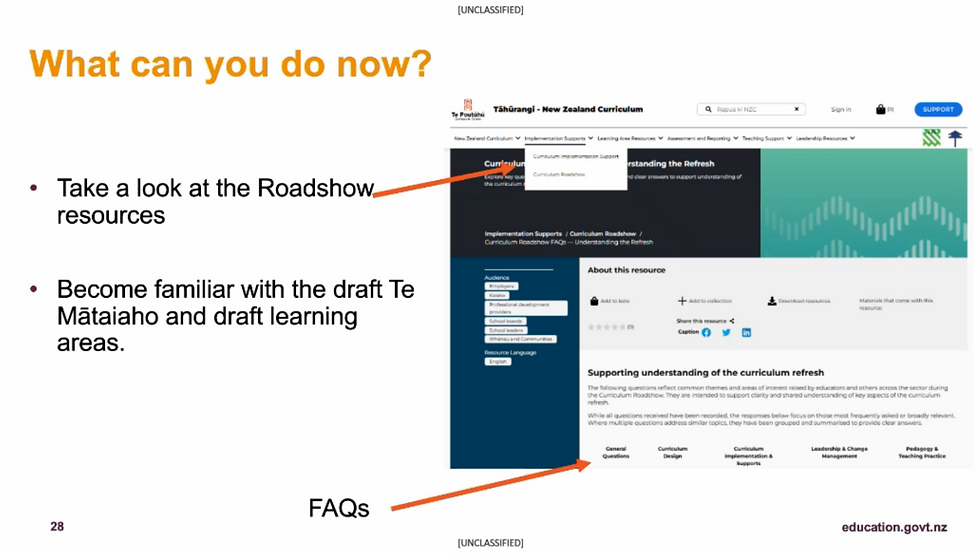 | We encourage you to become familiar with all the draft learning areas in the upcoming months. Take a look at the FAQ resources on the Roadshow area of Tāhūrangi. You can find these by typing Roadshow into the search or in the dropdown menu under implementation supports in the top navigation stream. The video recording of this presentation will be published on Tāhūrangi in a few days. Just go to the New Zealand Curriculum Online page and select the Unpacking the NZC Learning Areas presentations tile on the latest news carousel. We'll be inviting teachers and schools to participate in the in-class trialing of the draft learning areas in Term One next year. Keep an eye out on Tāhūrangi and the bulletin for school leaders for more information on this. |
 | Here you can see the email address for any questions or feedback that come out of this presentation. When you've had a good look through the draft science learning area and Te Mātaiaho and are ready to share your feedback or suggestions to it, there's a form on Tāhūrangi to complete this. Consultation closes on Friday, the 24th of April, 2026. |
 | That’s our presentation for today. Thank you very much. I will close with karakia. Kua hikitia te kaupapa, Kua takoto te wero, Me hoe tahi i runga i te whakaaro kotahi, Tiaki tō tāua oranga Kia kaha ai mo te tuku taonga Kia tutuki ngā hiahia mō Ka Hikitia Tihei mauriora! Ki te whai ao! Ki te whao oranga e! Mauriora! |


Comments